Who runs where and to what effect? Linking party nominations and party system change: evidence from the French 2024 legislative elections

Première parution : Emilien Houard-Vial · Marion Jacquet-Vaillant, « Who runs where and to what effect? Linking party nominations and party system change: evidence from the French 2024 legislative elections », French politics, vol. 24, 2026, pp. 382-408.
Governed by a minority government since 2022, France plunged into further instability with the unexpected dissolution of the National Assembly following the 2024 European elections. Due to the proximity of the summer holidays and constitutional provisions (general elections must take place within twenty to forty days), the snap elections happened within a short time frame: parties had just one week to nominate their candidates. Furthermore, this dissolution occurred in the broader context of a long-term reshaping of the party system, that has been amplified since 2017, with the emergence of an independent center and the increasing success of the far right. The 2024 elections thus functioned as a “stress test” for political parties, particularly on the right. The growing electoral strength of the main far-right party, the Rassemblement national (RN), reinforced by its 31.4% score in the European elections, increased its attractiveness for ambitious candidates. This dynamic affected not only the other far-right party, Reconquête! (R!), led by Éric Zemmour, but also the mainstream right represented by Les Républicains (LR). The defection of LR’s president, Éric Ciotti, who created his own movement (the Union des Droites pour la République, UXD in this article) and allied with the RN, epitomized this process, turning this period into a critical moment. The issue of party nominations was particularly salient in these elections, to evaluate each party’s strength: which parties managed to nominate the most candidates, and how attractive were party labels for right-wing voters? Can we use party nominations to assess the hegemony of the Rassemblement national (RN) in the right-wing pole? To address these questions, we examine the electoral configuration of the 577 legislative constituencies, through an analysis of candidate placements by political parties, first as a dependent variable reflecting party strategies and second as an independent variable constraining the electoral results.
Literature review & theoretical framework
With our empirical study, we aim to contribute to the longstanding (Duverger 1951) and continually renewed discussion on the evolution of the French party system, by proposing an alternative methodological and analytical perspective.
This discussion is dense and fueled by two complementary perspectives. The first one, focusing on the demand side, examines the values of party electorates (Grunberg & Schweisguth 1997) as preludes to electoral realignments. The second strand, focused on electoral outcomes, looks at the distribution of votes (Martin 2000a) or seats (Ehrhard 2016) to identify relevant parties. Collectively, these studies show that from the 1980s onwards, the bipolar party system gradually split into three blocs following the rise of the FN (Bornschier & Lachat 2009; Martin 2000b). Yet parliamentary representation did not reflect this tripartition (see Appendix 1), notably due to the majoritarian electoral system which maintained a bipartisanship (Grunberg & Haegel 2007).
Between 2007 and 2017, the system entered a period of chronic instability: the left became fragmented, the FN, despite growing electorally, was rarely able to win seats, and the right oscillated between its centrist tradition and a temptation to shift further right. Whether the FN and LR might eventually coalesce into a single bloc became a salient issue (Martin 2017a; Gougou and Persico 2017). This tension was partly resolved by the 2022 « consolidation » (Gougou 2022). By jointly analyzing values, votes, and parliamentary composition, Gougou et al. (2024) show that the tripartition of the electoral arena (values and results) is now mirrored by a tripolarization of parliament (seats). Within the right-wing bloc identified by Pierre Martin (2017a, 2017b), the position of Les Républicains (LR) as a party remained uncertain, straddling both the radical-right bloc and the centrist-Macronist one. Despite an ad hoc alliance with the central bloc in governments formed after the dissolution, LR still refuses any alliance with either neighboring bloc and asserts its independence. Studying LR alongside the RN and Reconquête (R!) does not imply that LR belongs to the radical right family; rather it allows us to empirically assess the shifting boundaries of this bloc and LR’s place within it. The 2024 electoral sequence revived these tensions in an acute manner.
Despite this rich literature, a dimension remains understudied: the electoral supply. Indeed, most analyses focus on demand-side dynamics/electoral outcomes, but few investigate the strategic deployment of candidates across constituencies. Yet, electoral supply appears crucial, as it shapes the structure of political competition, constrains voters’ choices, and thus affects electoral results, both in votes and seats. Based on this gap, our intention is to approach party system reconfigurations through electoral supply, examined through the analysis of candidates’ partisan endorsement. To our knowledge, this approach has few equivalents in existing literature: studies on configurations of party supply are rare, both in French and English-speaking literature (Gougou and Labouret 2013). By focusing on candidate nominations and labels, this article fills this gap and proposes a complementary perspective on party-system change. Its results also contribute to the understanding of the mainstreaming processes of radical right parties in established democracies: as a pariah party (Moffitt 2022), the Front/Rassemblement National has always sought to adapt to the political system (Dézé, 2003) by pursuing alliances or co-opting political defectors from other parties (Dahani et al. 2023).
Hypotheses
We analyze party supply configurations across the 577 constituencies of the French 2024 legislative elections, under the assumption that candidate placements reflect organizational strategies (withdrawals, alliances, focusing efforts on some territories at the expense of others, etc.). Firstly, we expect candidate placement to respond to both national-level goals and constituency-level constraints, as placement is generally the result of a centralized decision process made to maximize each party’s or coalition partner’s results (Di Virgilio 1994: 520–521), through optimized candidate selection (Butler and Miori 2024). In this particular configuration, LR’s and R!’s ability to nominate candidates, and the distribution of districts between the RN and its UXD ally, were the most important issues. This leads to a first set of hypotheses on the determinants of party supply:
- H1a. Parties prioritize the nomination of candidates in constituencies where their past electoral performance has been strongest.
- H1b. To position UXD candidates, past results of Les Républicains are more important than those of the RN.
To test H1a, we first examine descriptively the relationship between past electoral performance and candidate placement for each party. We ultimately use a binomial logistic regression model to estimate the probability of a constituency fielding a UXD rather than an RN candidate. Independent variables include vote shares from the 2024 European and the 2022 Legislative elections and the outgoing MP’s parliamentary affiliation, while controlling for constituency-level sociodemographic variables that commonly correlate with LR/RN voting patterns. H1b is specifically tested by comparing the magnitude of coefficients for LR vs. RN European vote shares.
Secondly, we expect voters to resort to common shortcuts (Burnett and Tiede 2015; Kirkland and Coppock 2018), and as such, we expect candidates’ party labels and incumbency to influence vote distributions, with a devalued LR label following the leadership crisis and the will of the UXD to attract LR voters, which would have benefited the RN’s new hegemony over the right-wing pole. This leads to a second set of more specific hypotheses:
- H2a. The UXD label increases support for RN candidates while reducing support for LR and Reconquête (R!) candidates in both rounds.
- H2b. The absence of an official LR label increases the vote for the right-wing candidate and reduces the vote for the RN and R!.
- H2c. Incumbency has a positive effect on the vote share of the candidates, whether LR or RN candidates.
To test H2a to H2c, we first examine descriptively the evolution of party performance through time across constituencies. We then use linear regression models, to predict each party’s score. Independent variables include each party’s 2022 legislative vote share (baseline), the presence of a UXD candidate rather than an RN candidate (tests H2a), the presence/absence of R!, LR (official vs. assimilated), and Ensemble candidates (tests H2b), and the parliamentary group of the outgoing MP (tests H2c). We still control for constituency-level sociodemographic variables as in the previous model. To test H2b, we distinguish between official and assimilated LR candidates (outgoing LR MPs and local notables who ran without the party label, see below), allowing us to assess whether the devalued party label affects performance. To test H2c, we examine the coefficients for incumbency by parliamentary group, expecting positive effects for LR and RN incumbents on their respective party’s vote shares.
Thirdly, we expect labels to play an even more important role in the second rounds, with only two or three candidates. In particular, RN candidates got qualified in most second round configurations, with calls to block the election of far right MPs, which leads to:
- H3. RN candidates perform better in runoffs against left-wing candidates than against Ensemble or LR candidates, especially when facing non-incumbents.
To test H3, we first assess descriptively second-round dynamics by examining candidate withdrawals, victory rates in various configurations and vote transfers in 2022 and 2024. We then conduct a linear regression that estimates the RN candidates’ second-round score in head-to-head runoffs. Independent variables include first-round score (baseline), the label (UXD/RN), the opponent’s label, whether the opponent was the incumbent or from the incumbent’s party, the turnout and the proportion of blank and spoiled ballots (separately and in interaction) and the same constituency-level sociodemographic controls. We examine whether coefficients for opponent labels show that RN performs worse against Ensemble/LR than against left-wing parties, and whether the incumbency coefficient shows that facing an incumbent opponent reduces RN performance.
More generally, we approach the strategic placement of candidates, the use of party labels, and incumbency as joint factors of the overall reconfiguration of the right and far right bloc across constituencies, providing a general framework for vote distributions. Specifically, we expect the emergence of a right–far-right coalition to strengthen the performance of the RN, leading to a consolidation of the new electoral order.
Data & methods
To describe the configuration of the political supply in each of the 577 French constituencies, to analyze party nomination logics and to examine the electoral results of right-wing and far-right candidates, this article relies on an original database. It was built from Ministry of the Interior data on the 2022 and 2024 legislative elections (the boundaries of legislative districts have been unchanged since 2012), as well as the 2024 European elections. For each candidate, the database thus includes first-round and, where applicable, second-round results from the Ministry’s official tallies. However, because the Ministry’s information on candidates is sometimes imprecise, these data were corrected and recoded during the campaign period, drawing on up-to-date press information about candidates.
For the 2022 elections, we used the recoding proposed by the LEGIS-2022 project (LEGIS-2022 2022). For the 2024 legislative elections, we conducted this recoding ourselves, following the LEGIS-2022 project’s method (especially for candidates labelled as “Miscellaneous center” or “Miscellaneous right”, since “Miscellaneous far right” were few in number). Our recoding follows a clear procedure. First, we collected the labels reported in the Ministry’s files. Second, we systematically compared them with publicly available information at the national or local level (party press releases, declarations in the local press or candidates’ campaign material). In cases where multiple labels were used, we prioritized (1) official party endorsement, (2) explicit public support from party leaders or local notables, and (3) self-identification expressed during the campaign. This ensures consistency across elections and comparability with existing datasets such as LEGIS-2022.
The 2024 snap election presents specific challenges due to the alliance between Éric Ciotti and the RN, which was quickly rejected by the vast majority of LR leaders and caused the rejection of the LR label by several incumbent candidates. As a result, we had to check carefully for LR-related candidates who were not officially labeled as such, as well as RN/UXD candidates who could be considered « Ciottists ». Each candidate was classified in one of the following categories:
- LR: candidates who were officially nominated by the party and accepted the nomination and label.
- LR “Assimilated”: candidates who did not display the official LR label, but were not nominated by other parties and were (1) outgoing LR MPs; (2) LR party members; or (3) publicly supported by LR or Centrist leaders — similarly, about thirty candidacies financially linked to LR but without the label, and about forty candidacies linked to a micro-party allied with LR. This category is essential because such candidates were likely to join the LR parliamentary group and it captures LR’s historical strategy of alliances with small centrist parties and local notables. In cases where candidates were supported by both Ensemble (“Together”, Macronist) and LR without expressing an explicit preference, we relied on their publicly declared affinities.
- UXD: not an official electoral/partisan label, but one created by the Ministry (meaning Union of the Extreme Right, as the UDR was not yet officially created), used here to identify candidates supporting Éric Ciotti’s call for an LR–RN alliance and who were nominated in the framework of this alliance. The Ministry counted 63; we included 7 more. Not all of them came from Les Républicains, but some from other small far right parties, and not all remained loyal to Ciotti (three “UXD” MPs, already close to the RN, joined the RN parliamentary group).
- RN: candidates who were officially nominated by the RN.
- REC: candidates who were officially nominated by REC.
Since we focus on partisan supply, our main goal is to identify candidates endorsed by right-wing and far-right parties, and small differences can arise between our dataset and others, for instance the FERD database (see Appendix 2), which focuses on formal party belonging (Gougou 2025a).
Results
Party nominations: a stress test for right-wing opposition parties
The snap legislative elections saw a general decrease in the number of candidates: on average, seven candidacies were presented per constituency in 2024 compared to eleven in 2022, which has never been seen since 1988, when bipolarization was particularly strong (Gougou and Labouret 2013: 79). This section will test hypotheses H1a and H1b.
Les Républicains: the resilience of a weakened and discredited institution
In a context marked by an ongoing party division, what happened to LR nominations? Firstly, the party officially nominated 305 candidates, down from 452 in 2022: this constitutes a significant drop illustrating the difficulty in finding candidates within a short timeframe and under improvised leadership. Secondly, we note that 91 candidacies are classified as “LR assimilated”, including some incumbents, which indicates a devaluation of said party label.
Regarding nominations, local dynamics proved significant. In some departments (for visualization, see Appendix 3), LR federations took the lead in negotiating arrangements with the outgoing majority (i.e., Hauts-de Seine, Nord). In Normandy, regional president and president of The Centrists party, Hervé Morin, oversaw the nominations of “assimilated” candidates. In several constituencies, LR leaders ran without the party’s label, notably in regions where the RN is historically less successful and where a moderate political tradition prevails, prompting local right-wing figures to distance themselves from the Ciotti crisis (Brittany, Pays-de-la-Loire). Conversely, there was a shortage of candidates in departments where the right’s scores were low, where local elected officials lacked strong networks, with few outgoing MPs, and where federal structures had been weakened (i.e., Hérault, Aveyron, etc.).
Beyond local dynamics, electoral considerations appear decisive: the proportion of constituencies without any LR candidate dropped from 40 to 20% when moving from the first to the fifth quintile of constituencies ranked by votes received in the European elections (Fig. 1). Similarly, the proportion of constituencies with LR assimilated candidates was highest in the fourth quintile, where fewer outgoing LR MPs were present and which received less attention from the party leadership than the fifth quintile, yet remained attractive to local elected officials. Nevertheless, it is notable that 41 of the 113 best-performing constituencies lacked an official LR candidate in 2024. The 2024 European elections constitute a first indicator of parties’ strength, as they were the most recent electoral results available for party leaders and showed significant changes compared to previous elections. If we consider the 2022 legislative results, a similar gradient appears: the share of constituencies without any LR candidate is highest in LR’s weakest territories and falls sharply in its strongest one, while both official and assimilated candidacies become more prevalent as one moves toward the upper quintiles.
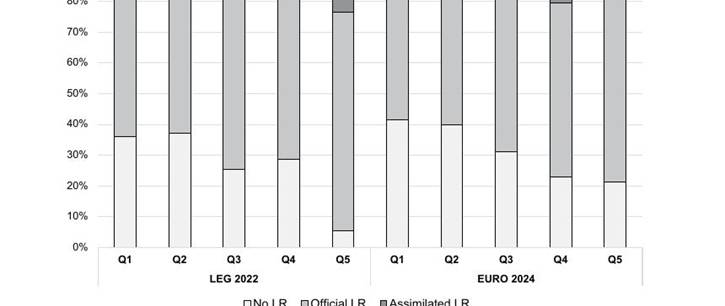
Fig. 1 Presence or absence of an official or assimilated LR candidate in constituencies in 2024 by quintile of LR scores in the 2022 legislative elections (left) and by quintile of the Bellamy list’s score in the 2024 European elections (right)
The Ciottist candidacies: a strategic extension of the far right influence
70 candidates associated with Ciotti’s list are labeled UXD. The number of constituencies secured was crucial to form a parliamentary group (at least 15 MPs) and to establish bargaining power vis-à-vis the RN, but the distribution of these constituencies was just as important. UXD candidates are more numerous in the two quintiles of constituencies most favorable to the right in the 2024 European elections (Fig. 2). For the RN, the pattern is more mixed: UXD candidates were most numerous in the third quintile of prior RN vote share in the European elections.
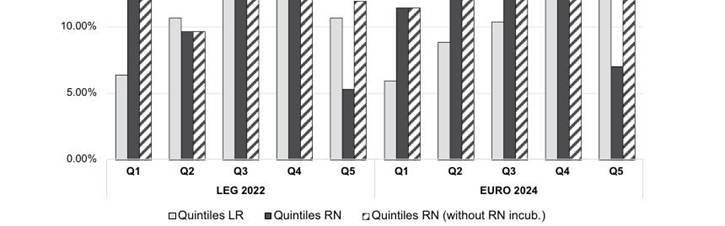
Fig. 2 Proportion of UXD candidacies by quintile of LR (light) or RN (dark with incumbents, hatched without) vote share in the 2022 Legislative elections (left) and in the 2024 European elections (right)
Excluding constituencies with RN incumbent candidates – presumably reserved for the RN, with the only exception being the 17th constituency of the Nord, where the RN incumbent did not stand again and it was allocated to Thierry Tesson (UXD), who joined the RN group once elected – UXD candidates remained most concentrated in the third and fourth quintiles. We observe similar dynamics when considering the 2022 legislative elections.
In other words, the geographical distribution of UXD candidacies only partially overlaps with RN strongholds (Table 1). For instance, their absence in the Mediterranean basin is the consequence of the high number of RN incumbents. Their presence is limited in the northeast of France and the western outskirts of Île-de-France. About ten constituencies where the RN exceeded 40% in the European elections were allocated to Ciottists. Yet most UXD candidacies were located in territories identified as potential zones for RN expansion and thus in areas where the mainstream right remains relatively strong (western part of the Paris area, Savoie), with sociological profiles favorable to the center-right, sufficient to hope for respectable scores, though unlikely to secure victories (apart from candidates already established locally, such as mayors or former MPs, parachuting was common for UXD candidates, which tends to downplay the question of the availability of “local” candidates in the allocation of constituencies).
Interestingly, only three UXD candidates were nominated in constituencies where LR MPs had been elected in 2022 (Fig. 3). This is a surprising finding if we assume they would most likely split the right-wing vote and thus increase their chance of capturing the seat. UXD candidates faced incumbents from the Ensemble coalition (68.7%), especially Renaissance (47.1%), compared to 43.4% and 26.8% among all incumbents. Its coalition partner, the RN, was logically underrepresented. This was also the case for NFP incumbents (21.4% of UXD candidates faced an NFP incumbent, while they account for 26.2% of all incumbents). This pattern reflects the transformation of traditionally right-leaning constituencies absorbed by Macron’s party after 2017, whose sociological profile overlapped with that of LR (Houard-Vial 2022a). As we will see in testing H2c, this incumbency configuration shapes first-round vote dynamics.
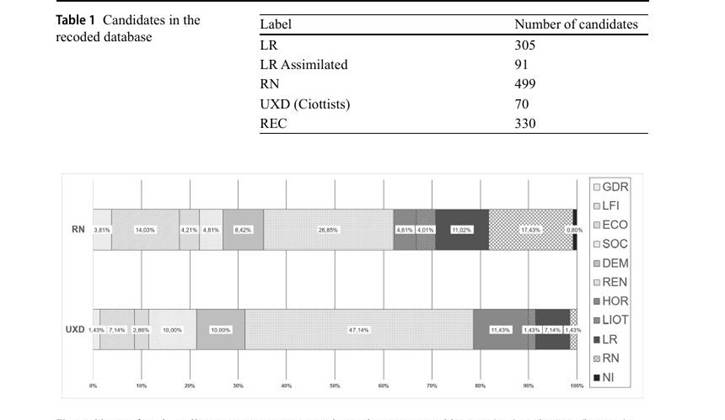
Table 1 Candidates in the recoded database · Fig. 3 Share of each parliamentary group among incumbents opposed by RN (top) and UXD (bottom) candidates
To assess the relative impact of different factors in the distribution of UXD candidacies, we used a binomial logistic regression model estimating the probability that a constituency would have a UXD rather than an RN candidate (Table 2, excluding constituencies without an UXD–RN coalition candidate, and some overseas constituencies that lacked sociodemographic data provided by INSEE). The first model (first column) measures the impact of the vote share received by Bellamy’s and Bardella’s lists in each constituency, and the parliamentary group of the outgoing MP. We also added sociodemographic control variables from INSEE at the constituency level, often mentioned as factors in LR or RN votes. We also estimated a second logistic model based on the 2022 legislative scores (Table 2, second column), to check whether the effects do not depend on the type of election.
| Constituencies’ variables | Logistic regression — European (p-value) | Logistic regression — Legislative (p-value) |
| LR score (European election) | 1.221 (0.026)** | – |
| RN score (European election) | 1.097 (0.003)*** | – |
| LR score (legislative election) | – | 1.029 (0.342) |
| RN score (legislative election) | – | 1.064 (0.102) |
| Incumbent’s group: LFI | 1.116 (0.874) | 0.530 (0.423) |
| Incumbent’s group: EELV | 1.781 (0.528) | 1.198 (0.845) |
| Incumbent’s group: SOC | 3.094 (0.078)* | 2.094 (0.292) |
| Incumbent’s group: REN | 1.244 (0.646) | 1.245 (0.648) |
| Incumbent’s group: HOR | 1.487 (0.514) | 1.120 (0.863) |
| Incumbent’s group: LIOT | 0.200 (0.182) | 1.354 (0.826) |
| Incumbent’s group: LR | 0.258 (0.046)** | 0.243 (0.095)* |
| Incumbent’s group: RN | 0.031 (0.003)*** | — |
| Control: median age | 1.015 (0.763) | 1.038 (0.480) |
| Control: % non-rural population | 1.003 (0.836) | 1.002 (0.888) |
| Control: % blue-collar labor force | 0.937 (0.211) | 0.981 (0.728) |
| Control: % 3+ years of higher ed | 0.963 (0.363) | 0.960 (0.307) |
| Control: % wealthy households | 1.059 (0.158) | 1.093 (0.020)** |
| Control: % poor households | 0.998 (0.959) | 0.998 (0.971) |
| Control: % far from usual services | 1.000 (0.990) | 0.990 (0.667) |
| Observations / Pseudo-R² / Constant | 549 / 0.1664 / 0.006 | 449 / 0.1572 / 0.016 |
Table 2 Logistic regression models modeling the likelihood of a UXD rather than an RN candidate in a constituency. Reading note: all things being equal, a constituency with an LR incumbent MP is 0.258 times less likely to have a UXD rather than an RN candidate compared to a constituency with a MoDem incumbent. One star indicates significance at the 90% level, two at 95%, three at 99%.
The model confirms the importance of LR and RN votes in the European elections: each significantly increases the likelihood of a UXD candidate, with a stronger effect, all things being equal, for LR vote (22% higher chance for each percentage point more LR vote vs. 9% for RN vote). Thus, constituencies most favorable to the RN were mostly kept for the RN, while those favorable to LR were left to UXD candidates. Logically, the model confirms that having an RN incumbent has a negative effect on the probability of seeing a UXD candidate in a constituency. Additionally, still holding LR vote constant, there is a negative effect of having an LR incumbent MP in the constituency (these significantly lower chances hold regardless of the reference category, except for LIOT incumbents, where there was only one UXD candidacy). There is also a positive effect of having a PS incumbent: in these generally rural areas outside RN strongholds, a UXD candidate – more centrist, mainstream – was preferred (this significantly higher chance only holds for the reference categories MODEM and LIOT). Finally, the only sociodemographic variable with a significant effect is the proportion of wealthy households, suggesting a focus on affluent constituencies where voters might be drawn to alternatives to LR – typically the western Île-de-France area. The second model based on the past legislative elections only includes 449 observations. The coefficients for LR and RN scores are consistent with those from the 2024 European election model but not statistically significant. Yet, the LR incumbent still has a significant negative impact on UXD candidacies, while the share of wealthy households has a significant positive effect.
The destabilization of a young and weakened institution: the disappearance of R! candidates
In 2024, R! fielded candidates in 330 French constituencies, just over half (57.2%). This was a sharp drop from the 2022 legislative elections, when the party had nominated 551 candidates (95.5%).
In constituencies where R! had its lowest scores in the 2024 European elections, only 44% fielded an R! candidate in the legislative elections, whereas this share rose to 74.6% in constituencies where the party had its highest scores: R! concentrated its resources on electoral strongholds (Fig. 4), for instance in the Paris region constituencies. Conversely, R! presented more candidates in constituencies where the RN performed poorly and fewer where the RN was stronger (74.1% in Q1 vs. 54% in Q5), suggesting that in 2024 R! often chose to avoid direct competition with the RN in its strongholds. Looking at candidacies relative to the 2022 legislative results, even clearer patterns emerge: R! fielded candidates in its strongholds of 2022 and in constituencies where the RN was weak, while investing less in its weaker areas and in RN strongholds. The Provence-Alpes-Côte d’Azur region offers a striking illustration: an RN stronghold, the region saw 39 R! candidates in 42 constituencies in 2022, achieving some of the party’s best results; but in 2024, there were only 32 candidates, with a sharp drop in the Alpes-Maritimes (from 8 in 2022 to 3 in 2024) and a complete absence in the Hautes-Alpes.
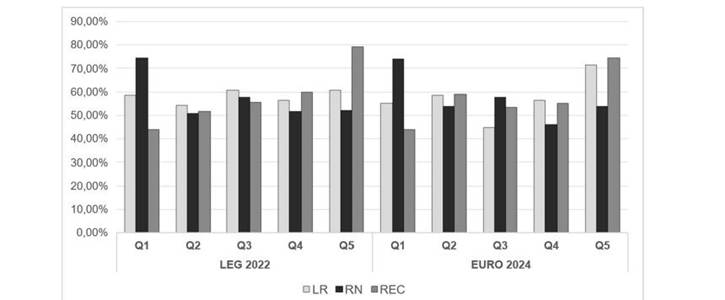
Fig. 4 Proportion of R! candidacies by quintile of LR (light), RN (dark) or REC vote share in the 2022 Legislative elections (right) and in the 2024 European election (left)
How can we explain these changes? One hypothesis is the party’s youth: confronted with the 2024 legislative elections, a still professionalizing party lacked preparation and human resources, making it impossible to match its 2022 number of candidates. The 2022 campaign had generated many candidate applications, but by 2024, the party had begun organizing nationally and locally (Jacquet-Vaillant 2024), so youth alone cannot account for the drop. A more decisive factor was the party split following the European election. After the dissolution was announced, Marion Maréchal unilaterally sought an agreement with the RN, was rebuffed and then called for support of RN-UXD candidates, leading to her expulsion. This triggered local disruptions: in several departments, local leaders refused to run under the R! label or to support official candidates, sometimes depriving their constituency of any R! candidate as in Vienne or Ardennes (Blanchard 2024). In some cases, replacements were found, such as in the Bouches-du-Rhône, where a loyal deputy delegate ensured full coverage of constituencies despite local resignation (Marigot 2024). Some R! leaders close to Maréchal even crossed over to join the RN-UXD union, illustrating the fluidity of allegiances. Agnès Marion and Thibault Monnier, both former RN members who had joined R! in 2022, were nominated by the RN in favorable constituencies. Thus, the 2024 Reconquête! nominations resulted from two opposing processes: the strategic intention to field as many candidates as possible, in the party’s strongholds, to meet public funding thresholds and maximize electoral gains vs. organization weaknesses and internal conflict. This explains the drop in candidacies.
These results confirm H1. Parties positioned their candidates strategically based on past electoral performance (H1a): LR, RN, R! fielded candidates in their strongholds and avoided others’ bastions. When choosing between RN/UXD candidates, constituencies most favorable to the RN were reserved for its candidates, while those with stronger LR support were assigned to UXD candidates. LR struggled to field official candidates in departments with weak networks, whereas LR “assimilated” candidates were concentrated in regions where local party figures retained influence. Similarly, R! internal conflicts constrained candidate placement in certain constituencies. Finally, H1b is confirmed, with LR vote shares having a stronger effect than RN results on the allocation of UXD candidates, reflecting the strategic targeting of LR-favorable constituencies to co-opt right-leaning voters without competing directly with RN bastions.
The tremors of electoral realignment? The hegemony of the Rassemblement National within the right
During these legislative elections, the Bardella-Ciotti alliance secured a third of the votes in the first round, with record turnout since the introduction of the five-year presidential term. The RN coalition more than doubled its number of votes in two years, while Reconquête! saw its vote divided by four and LR maintained its score (see Appendix 1). This section tests hypotheses H2a to H2c to examine the effects of party labels and incumbency on right-wing parties’ performance, after assessing the level of hegemony achieved by the RN on the right-wing pole, especially at the expense of LR and R!.
First-round results: the advantage of established parties and candidates
The first round of the 2024 elections revealed different trajectories for the three parties. First, Les Républicains’ results remained relatively stable. When considering only official candidates, the party’s vote share declined from 10.53% (2022) to 6.57% (2024). But the significantly lower number of constituencies with LR candidates must be accounted for: restricting the analysis to constituencies where official or affiliated candidates were fielded in both 2022 and 2024, the average score went from 13.05% to 13.29%. This increase reflects that uncontested constituencies in 2024 were often the least favorable plus the absence of Ensemble candidates in 78 constituencies. An analysis of the distribution differences between 2022 and 2024 in the 345 constituencies where LR was present both times (Fig. 5) shows that while the top quartile remained stable, with an increase in outliers in 2024, the median and the first quartile dropped. Thus, despite the mean’s slight rise in 2024, most constituencies saw a decrease in LR scores, sometimes sharply: in 82 constituencies, the score fell by more than 5 points in two years, including 19 with a drop exceeding 10 points.
If we consider the change in electoral score between 2022 and 2024, LR’s vote share fell by more than 4.8 points in the lowest-performing quarter of constituencies and rose by more than 1.6 points in the top quarter. Furthermore, the presence of an LR incumbent reduced the likelihood of being in the first quartile by over six points and doubled the chances of being in the fourth quartile.
In 2024, the RN/UXD alliance experienced unprecedented growth compared to the RN 2022 scores (Fig. 5): 39 candidates (including 2 UXD) won over 50% in the first round (vs. one in 2022) and over ¾ surpassed 25% (vs. less than ¼ in 2022). Even in traditionally resistant areas like Paris, scores increased substantially (the lowest 2024 score surpasses the highest 2022 score) and scores are no longer negligible: only 21 constituencies registered RN scores below 10%. A total of 443 candidates qualified for the second round (vs. 208 in 2022; participation increased by 17 points between 2022 and 2024, and this rise cannot be explained by a simple transfer of votes). Between 2022 and 2024, RN’s vote share increased in 563 of the 565 constituencies where the party (or UXD) ran candidates on both occasions. In a quarter of these constituencies the increase was below 12.1 points, while in the top quarter it exceeded 17.7 points. The presence of an RN incumbent reduces the likelihood of a smaller gain (or drop) and doubles the chances of a larger rise.
In contrast, R! experienced a sharp decline in 2024, fueled by the absence of incumbents. In the 319 constituencies where R! ran candidates both times, the party’s electoral collapse is stark (Fig. 5): there are only 2 constituencies where the score rose. In 76 constituencies, R!’s vote share fell below 1% (vs. 5 in 2022), and it topped 5% in only 2 (vs. 129 in 2022). These results confirm the advantage of incumbents for both LR and RN, while R!’s collapse highlights the effects of their absence, which is a first step in support for H2c.
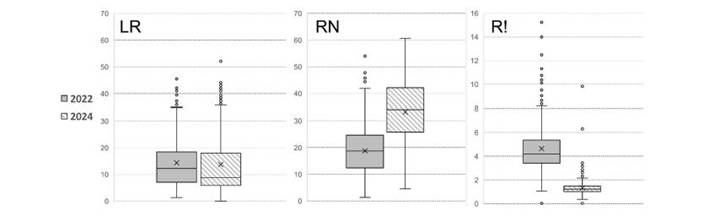
Fig. 5 Scores of official and assimilated LR, R!, and UXD/RN candidates in the first round of 2022 and 2024 in constituencies where each party was present both times (vertical scale varies for R!)
The RN’s hollowing-out of the mainstream right: a process close to completion
These dynamics suggest a communicating-vessels effect within the right-wing bloc, which can be clarified by examining the electoral geography. The geography of the RN vote has been remarkably stable since 2012 and the last redistricting of 2010 (Fig. 6). With the exception of the 2012 legislative elections and 2024 European, all RN scores by constituency are positively correlated, with coefficients above 0.75. The correlation is as high as 0.94 between the 2022 and 2024 legislative elections, showing strong persistence in the geographical stratification of the RN vote. While proportionally, the RN’s weakest constituencies saw larger relative increases (sometimes doubling their vote share), in absolute terms, the biggest gains still came in the party’s traditional strongholds: these high correlations in a context of overall rise of party score indicate that the extension of the RN concerns the entire territory.
For LR, the correlations are much less consistent. The sharp decline in correlations between LR scores in 2024/2017 (0.49) and in 2024/2012 (0.31) indicates that the party has lost much of its former territorial foothold, particularly in favor of Macronist MPs. The strong correlation with 2022 (0.76), combined with the over-performance of incumbents, suggests that its remaining strength is concentrated in a limited set of constituencies anchored by incumbent LR MPs acting as local notables. While 357 UMP candidates obtained over 25% in 2012, it dropped to 111 (2017), 50 (2022) then rose to 73 (2024), but only 28 if we exclude the districts without an Ensemble competitor. Of these 73, 49 had incumbent LR MPs. The stability of the R! vote is also particularly low (0.16 between the 2022 and 2024 legislative elections), likely due to the RN’s pull in 2024.
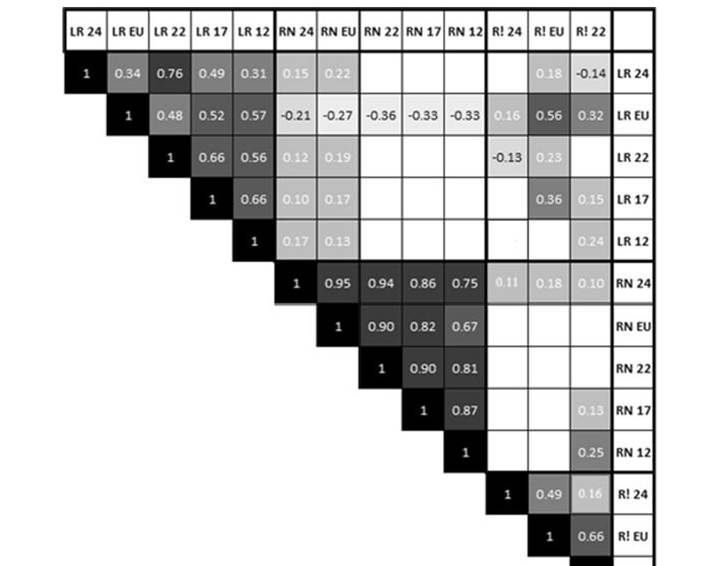
Fig. 6 Correlations of votes at the constituency level for RN, R!, and LR across the 2012–2024 legislative elections and the 2024 European election. Reading note: cells are shaded in gray by 0.25-point intervals; only correlations with a significance level above 95% are shown.
As for correlations between parties, the emerging correlation between RN/UXD 2024 scores and LR 2022 scores suggests that the far-right alliance gained ground in former LR strongholds. Moreover, RN growth between 2022 and 2024 and the 2022 LR are positively correlated (0.18, R² = 0.12) meaning that RN gains were larger in constituencies where LR had previously performed well. However, when considering longer-term changes since 2012 or 2017, this relationship disappears (correlation coefficients and R² proved insignificant when exploring LR 2017/2012 scores against RN evolution over the same longer periods), showing that the effect is short-term and context-dependent. From 2022 to 2024, therefore, the RN’s rise in LR strongholds contributed to its electoral success – for instance in the Alpes-Maritimes (see Appendix 4) – supporting the idea of a partial hollowing out of the mainstream right, which has already been undermined by centrist gains since 2017. More generally, the breakthrough of Marine Le Pen in 2022 among moderate right-wing voters (Houard-Vial 2022a), as well as the emergence of a Zemmour vote based on Fillon and Le Pen’s 2017 electorates, had already been documented (Jacquet-Vaillant 2023: 250). Polls also suggest that, in the 2024 legislative elections, the RN absorbed about 25% of Valérie Pécresse’s 2022 presidential voters or LR’s 2022 legislative voters, and 70–75% of Zemmour and R! voters (Wave 6 of the French Electoral Survey, Ipsos for Le Monde et al., 11,820 respondents; Ifop’s TF1/LCI survey, 2,806 respondents; and Harris Interactive’s “Jour du vote” poll for Challenges/M6/RTL, 6,081 respondents), which is consistent with our results.
Electoral dynamics shaped by party supply
To analyze the effect of the party supply configuration on the vote for the three parties, we used a multiple linear regression model (Table 3), including each party’s 2022 score, the presence/absence of an R!, LR (official or assimilated) or Ensemble candidate, whether a UXD candidate rather than an RN candidate was fielded (Ciottist candidates played on the ambiguity of their partisan affiliations, sometimes labelling themselves “Right-wing Republicans”), and the parliamentary group of the outgoing MP. Scores in the 2022 and 2024 legislative elections appear correlated, though with varying intensity depending on each party’s progression or decline. Moreover, if we observe a modest positive effect of having a UXD rather than an RN candidate on the R! vote, as well as a stronger and significant effect on the RN vote, this correlation is not significant for LR vote. At first sight, this suggests voters, all else being equal, did perceive UXD and RN candidates as different during the first round, at least in some instances. Still, we note that when excluding the singular cases of Éric Ciotti and Christine d’Intorni, the correlation disappears, suggesting that this difference is indeed confined to specific configurations, where UXD candidates are more likely to be well-identified and legitimized by right-wing voters given their previous position as LR MPs, even beyond their incumbent status. Moreover, the presence of an R! candidate did not significantly affect LR scores but reduced RN scores, albeit marginally, indicating that some voters are drawn specifically to the Zemmourist platform.
| Constituencies’ variables | RN vote T1 2024 | R! vote T1 2024 | LR vote T1 2024 |
| Party score in 2022 | 1.047 (0.000)*** | 0.091 (0.000)*** | 0.531 (0.000)*** |
| UXD rather than RN candidate | 1.040 (0.011)* | 0.182 (0.004)** | − 0.361 (0.665) |
| Presence of a R! candidate | −0.579 (0.035)* | Omitted | −0.940 (0.089) |
| Official LR (ref = absence) | −0.939 (0.003)** | −0.327 (0.000)*** | Omitted |
| Assimilated LR | −1.266 (0.002)** | −0.231 (0.000)*** | 2.992 (0.000)*** |
| Absence of an ENS candidate | −0.512 (0.231) | 0.364 (0.000)*** | 12.867 (0.000)*** |
| Incumbent LR | 3.150 (0.000)*** | −0.051 (0.595) | 7.130 (0.000)*** |
| Incumbent RN | 2.291 (0.000)*** | 0.163 (0.062) | 0.031 (0.978) |
| Incumbent LIOT | 3.506 (0.000)*** | −0.243 (0.129) | 1.715 (0.630) |
| Control: median age | 0.212 (0.000)*** | 0.004 (0.537) | −0.019 (0.822) |
| Control: % wealthy households | 0.087 (0.020)* | 0.013 (0.028)* | 0.037 (0.592) |
| Control: % poor households | −0.130 (0.000)*** | 0.006 (0.289) | −0.077 (0.261) |
| Observations / Pseudo-R² | 548 / 0.9331 | 306 / 0.4396 | 333 / 0.8414 |
Table 3 Multiple linear regression on first-round scores of the RN, R!, and LR candidates in the 2024 legislative elections, by constituency (abridged; full incumbent-group and control rows omitted here for space). Reading note: in constituencies where Ensemble did not field a candidate, the LR candidate’s score increased by an average of 12.867 points, controlling for participation and blank/null ballots.
The presence of an LR candidate tends to reduce RN and R! scores, though only slightly for the RN given its overall high level: its electorate seems relatively impermeable to right-wing alternatives. While there isn’t a significant difference between official LR and assimilated LR candidates in terms of effect, the assimilated LR candidates performed about 3 points better on average, all else equal, probably thanks to their local reputation and perhaps their more explicit rejection of an alliance with the RN, which may have appealed to centrist or abstaining voters.
The absence of an Ensemble candidate did not benefit the RN but significantly boosted LR’s performance (often the focus of Ensemble’s implicit support), with a 12.9-point gain — given that the average Ensemble score in these constituencies was about 20% compared to 25% overall in 2022, we can infer that about two-thirds of Ensemble’s potential voters went to LR and allied candidates. Table 3 also confirms the incumbency effect for LR (+7.1 points) and for RN candidates (+2.3 points). The positive effect of LR and LIOT incumbents on RN scores suggests that, independently of its 2022 score, the RN did better in constituencies rooted in the moderate or center-right – an effect that disappears when also controlling for the 2022 LR vote.
These results confirm the incumbency hypothesis (H2c), and also prove that when running without the LR label, LR assimilated candidates performed better than official LR candidates, whereas RN and R! scores fell (H2b). Yet, it does not prove that the UXD label strongly increased RN support or reduced LR/R! votes, which contradicts our hypothesis (H2a), even though this will be qualified in the next section. Overall, incumbency effects seem to dominate, whereas party-label arrangements seem to have a limited impact.
Second-round results: the last stand of the Republican front?
Numerous polls predicted the RN-UXD coalition would get the highest number of MPs after such impressive first-round results. But even though it gained one-quarter of the seats, the blocking strategy of its opponents prevented it from coming to power. This section will thus examine the H3 hypothesis on the effect of opponents’ label on RN-UXD chances during this second round.
Indeed, if the disproportionality between the coalition’s votes and seats (see Appendix 1) stems from the two-round majoritarian voting system (Lijphart 2012: 172), it also owes much to the withdrawal of candidates from other parties. Although the so-called “republican front” was adopted late by the Macronist coalition, it manifested clearly in the withdrawals of 134 NFP candidates and 82 Ensemble candidates, in constituencies where the RN came first (or close to first) and a three-way runoff was looming. LR, in line with the “ni–ni” doctrine (neither left nor RN), issued no guidance, despite the configuration being prominent in three-way races involving an LR candidate. Thus, among the 11 constituencies without a withdrawal and where the RN came first in the first round, in 7 an LR candidate stayed in the race, in 3 it was an Ensemble candidate, and in 1 an NFP candidate (in a three-way contest with the RN and another far-right candidate). Three LR or affiliated candidates withdrew voluntarily, and always in favor of the RN’s opponent. Conversely, there were 28 withdrawals in favor of LR candidates, exclusively by NFP candidates.
RN candidates won 80 of their 308 head-to-head runoffs (26%), with victory rates varying by opponent: they won 19 of 110 duels against ENS candidates (17.3%), 7 of 48 against LR candidates (14.6%) and 51 of 135 against NFP candidates (37.8%), up to 41.6% against LFI. As for UXD candidates, they won 14 of their 46 runoffs (30.4%). They won 3 of 24 duels against the presidential majority (12.5%) but 11 of 18 against left-wing NFP candidates (61.1%), including 4 of 5 against LFI (80%). Thus, UXD candidates have better electoral prospects when facing left-wing rather than centrist opponents and perform better than RN candidates. Overall, the RN/UXD coalition won 10 of the 11 triangular races where it led after the first round, but lost all the remaining 77 it contested. It won only 94 of its 354 head-to-head runoffs, a 26.6% victory rate, while LR and affiliated candidates won 82.5% of theirs.
Assuming stable victory rates, 7 RN/UXD candidates would have lost under a perfectly unified front, while 138 RN/UXD would have won had it been totally absent – coming close to an absolute majority in the National Assembly (280 vs. the 289 needed). These withdrawals therefore limited the number of seats won by the RN and UXD.
Regarding head-to-head runoffs, which were the most common configuration in 2022 and 2024, the RN’s runoff success rate declined in 2024 compared to 2022 (victory in 88 of 203 runoffs, 43.3%). In constituencies where the RN qualified in both 2022 and 2024, the RN’s score increased less between rounds in 2024 than in 2022 (Fig. 7). This is partly explained by better transfers of votes from small parties like R!, which collapsed in the 2024 first round and did not provide a second-round reservoir of votes (Fig. 5). It also appears as the result of two converging phenomena: first, in 2024, some voters who had supported the RN only in the second round in 2022 chose it already in the first round, so they no longer counted among the second-round reserves; second, greater mobilization in favor of the republican front in 2024, thanks to the visibility of the withdrawals. For instance, in Essonne’s 2nd constituency, the RN gained over 30 points between rounds in 2022 but only 12 in 2024 (same LFI opponent); in Tarn’s 1st constituency, the gain dropped from 33 to 4 points – resulting in electoral defeat.
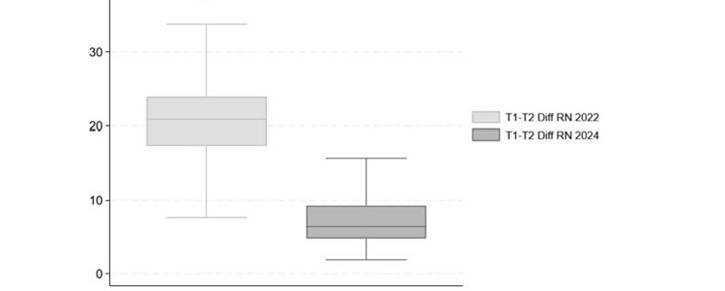
Fig. 7 Difference between the RN’s first- and second-round scores in the 2022 legislative elections (left) and 2024 (right), in constituencies where the RN was in head-to-head runoffs twice
What affects the RN or UXD candidate’s performance in the runoff? To test hypothesis H3, we conduct a linear regression that estimates the candidate’s second-round score based on its first-round score, whether it was UXD or RN, its opponent’s label, whether the opponent was the incumbent or from the incumbent’s party, the turnout and the proportion of blank and spoiled ballots (separately and in interaction), as well as sociodemographic control variables (Fig. 8). First, the RN vote increases with the number of blank and spoiled ballots, these ballots coming from voters who refuse to support the RN’s opponents, rejecting the logic of the republican front. But when blank/spoiled ballots and turnout rise together, this effect disappears: the additional voters who turn out counterbalance the lack of transfers, as they turn to the vote to block the RN. In this case, the mobilization counteracts the limited vote transfers and mitigates the impact. Second, facing an opponent aligned with the outgoing MP’s group is associated with lower RN/UXD vote shares: this shows the outgoing MP’s capacity to attract voters beyond their first-round base. The incumbency effect is not limited to the first round, but also visible in the second round.
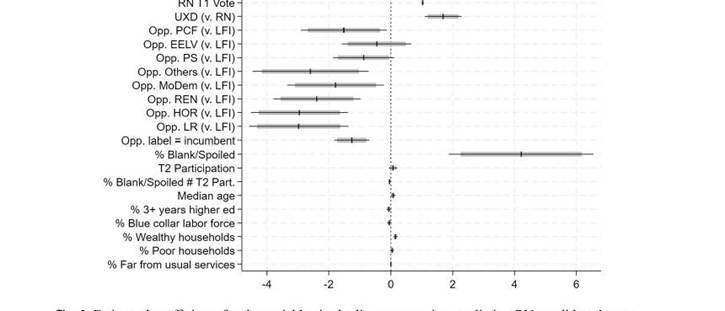
Fig. 8 Estimated coefficients for the variables in the linear regression predicting RN candidates’ second-round scores in head-to-head runoffs (90% and 95% confidence intervals shown)
Third, RN/UXD scores vary significantly with the opponent’s label. The RN scores highest against LFI, EELV, or PS candidates. Conversely, all else being equal, RN/UXD scores drop against other candidates, especially LR and Horizons. These effects partially match the results: the RN/UXD victory rate against LFI and PCF candidates (45–46%) is higher than against PS and EELV (36–37%), Horizons (25%), and Divers-MoDem, Renaissance or LR (under 20%). Thus, voters are more willing to block the RN in favor of a centrist or right-wing candidate than the other way around. Fourth, the regression shows a positive effect of UXD candidacies over RN candidacies on the second-round score, which was not seen in the first round.
To explain this correlation, we explored when the UXD label helped significantly compared to the RN label, by plotting the predicted RN second-round score based on both the opponent’s label and the RN/UXD candidacy (Fig. 9). First, the predicted score is significantly higher against an NFP candidate than against Ensemble or LR candidates – whether the far-right candidate is RN or UXD. Second, the predicted score is significantly higher for UXD candidates compared to RN candidates when facing an NFP opponent. A direct comparison of the net second-round gains (T2-T1) confirms this pattern: UXD candidates gained on average 11.41 points versus 9.82 points for RN candidates, and a t-test indicates that this difference is statistically significant (p = 0.027) despite the small number of UXD cases. This suggests that voters who supported neither the NFP nor the RN/UXD in the first round were more inclined to back UXD than RN. This label effect thus appears specifically in left vs. far-right second rounds, and shows that in this configuration a candidate associated until recently with the mainstream right is preferred.
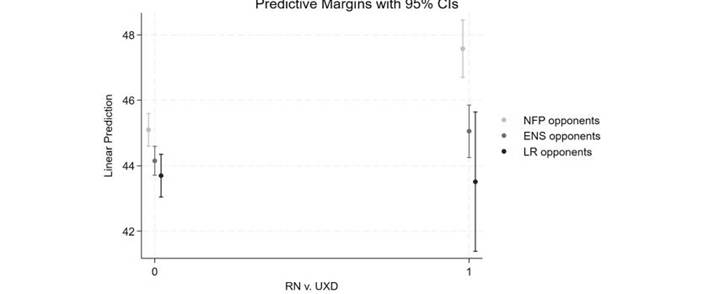
Fig. 9 Predicted values of the interaction effect between the presence of a Ciottist candidate and the opponent’s label on the second-round score in head-to-head runoffs
Conclusive discussion: understanding the new French party system
Our study aimed at putting forward the role of labels and party nominations in electoral realignments. As such, we chose to study the 2024 French legislative elections, which can be considered as a maintaining election in a brand-new electoral order (Gougou 2025b). The weight of the three blocs (left, center-right and far right) tends to remain stable, but significant changes can happen inside these blocs, and further developments can happen at the borders of each bloc, as realignments represent delayed, accelerated and multi-step responses to long-term social, economic and cultural transformations. We chose to focus on the far-right bloc by interrogating both the growing hegemony of the RN on this bloc and the way the mainstream right was challenged by a party it still wishes to co-opt.
We proposed two complementary perspectives on the role of labels and nominations. First, we approached it through the ability to nominate candidates and the strategy behind it. We demonstrated that parties had a rational view of nomination in order to maximize electoral results based on past performances (H1a) and possibly on past performances of other parties whose voters they wanted to poach (H1b), even though they may be limited by local human resources to find candidates, and even more to claim them as officially affiliated. We can thus confirm that labels are an issue that surpasses financial considerations for parties and candidates – whether to choose the right label or to refuse them, according to their perceived electoral value.
Second, we approached labels through their electoral effects, with mixed results regarding our hypotheses. We were able to confirm that, all things being equal, the absence of an official LR label was an advantage for LR-affiliated candidates (H2b) and that, beyond labels, incumbency – and more generally the personal notability of the candidates – was an electoral advantage in these elections, for both established (LR) and anti-system (RN) parties (H2c). Similarly, the label of RN’s opponents in run-offs was crucial for their victory chances, with an advantage against left-wing candidates (possibly concentrated on LFI and EELV labels), compared to center and especially right-wing candidates (H3). Although these results remain highly consistent with the spatial theory of the vote, these differences remain limited, confirming that RN possesses limited potential for progress in second rounds, with potential voters already attracted during the first round and other voters still globally deterred by this label. Our results show that the UXD label is only an advantage in the second rounds and against left-wing opponents, exposing that UXD candidates were largely assimilated to the RN (with no attraction differential in the first round), but that their profile (partially linked to the mainstream right) was less repulsive for voters of the center-right bloc when no “natural” candidate is available (nuanced H2a). To conclude, our results show that labels play essentially a negative role in the adjustments of these maintaining elections, confirming the negativization of partisan affiliations in contemporary France (Tiberj 2024: 245–249).
This article demonstrated that analyzing the partisan supply at the constituency level is a good way to reveal party strategies and the systemic dynamics they directly shape, and to understand the consolidation mechanisms of new party systems. The RN, which is generally considered to be weakly structured at the local level, built on its 2022 victories to establish real strongholds especially in the northern-eastern part of France and on the Mediterranean coast, with further successes in former right-wing strongholds—even though the general geographical distribution of RN’s vote remained stable.
In doing so, this article contributes to ongoing discussions on the electoral success of the far-right and more broadly on the mainstreaming of the RN. The far-right bloc has gained the largest electoral support, which is likely to remain stable over the coming years, and broke the glass ceiling which has kept it far from national power for several decades. From this perspective, the effectiveness of the alliance with Éric Ciotti and the marginalization of Zemmour’s threat are two striking successes in RN’s history that were empirically demonstrated. However, this analysis of the 2024 legislative elections also proved that the counter-mobilization from a large part of its opponents and of the electorate remained strong and relegated the far-right coalition to third place in terms of seats, confirming a long-lasting effect of the French electoral system (Ehrhard 2016).
The RN nonetheless benefited from the weaknesses of the mainstream right, which created the conditions for an alliance by radicalizing its positions in order to co-opt the RN’s electorate (Houard-Vial 2022b), an unsuccessful strategy (Krause et al. 2023) which is likely to have normalized far-right ideas (Valentim 2024). Weakened by this crisis (almost a year was necessary to elect a new leader) and still deeply uncertain about their strategy, Les Républicains nevertheless survived these elections with a retrenched parliamentary group, and managed to participate in governmental coalitions (Barnier’s and Bayrou’s). LR retained a significant role in national politics thanks to its local notables, a remaining common cohesive identity centered around the proximity to power (Houard-Vial 2022b) and the help of the Macronist forces, which got closer to LR’s ideological (Rouban 2023) and electoral (Jaffré, 2023) bases. Its role in the center-right bloc could be decisive when the Macronist forces lose their raison d’être and rallying point (the support to Emmanuel Macron’s presidency). While the electoral results of this bloc have been rather disappointing since 2022, its attitude towards the other two blocs it both denounces as extreme and spares in times of necessary compromises, will be decisive for shaping the power apparatus (Gougou 2022: 921) of this new electoral order.
Appendix 1
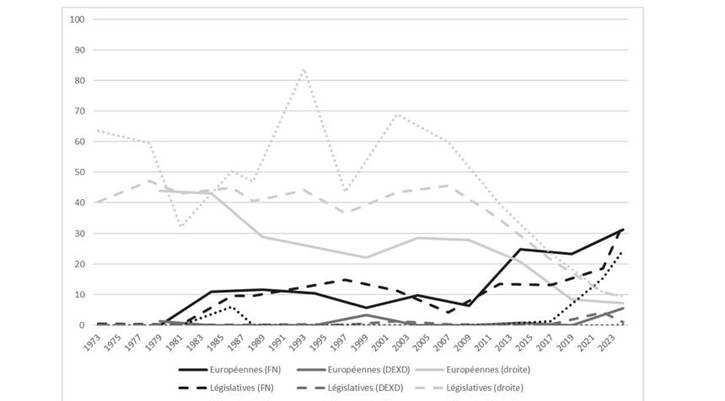
Fig. 10 Share of votes cast and share of seats in the National Assembly won by the FN/RN, other far-right forces, and the mainstream right since 1973. Other far-right forces include those classified as such by the Ministry of the Interior, the MNR, and R!, but not the sovereigntist right (MPF, RPF, or DLF). The “right” includes electoral coalitions of Gaullist and post-Gaullist parties (including the UDF but not MoDem). The seats shown are those won in legislative elections, not those of parliamentary groups formed afterward.
Appendix 2
The different logics between our database and the FERD database led to minor coding discrepancies (see Table 4 in comparison with Table 1) which should be seen as systematic differences stemming from distinct research questions. The two databases pursue different analytical objectives that are reflected in coding practices and explain observed discrepancies: our database codes candidates based on organizational support received for the 2024 legislative elections, while FERD reflects party or coalition affiliation. In most cases, the two overlap but this is not automatic.
| Label | Number of candidates |
| Les Républicains (LR) | 300 |
| Miscellaneous right endorsed by LR (UDC) | 85 |
| Rassemblement national (RN), including ciottists | 570 |
| Including « RN » | 496 |
| Including « RAD » (Ciottists) | 65 |
| Including « UDD (DSV) » | 2 |
| Including « UDD (EXD) » | 7 |
| Reconquête (REC) | 330 |
Table 4 Right and far-right candidates in the FERD database (NIV 3 and NIV 2)
For instance, in the 4th constituency of the Loire, Gerbert Rambaud is coded as “DSV” (sovereigntist) in the FERD database, but is coded RN in our database. He indeed belongs to the sovereigntist party Debout la France, but he was also the official RN candidate in that constituency, and was presented as such in the local press (Le Progrès). We identified 4 similar cases. Similarly, approximately 40 candidates we coded as “LR-affiliated” are coded as UDC (Centrist Union) in FERD, reflecting their broader coalitional positioning beyond LR. Conversely, approximately 30 candidates coded as « LR-affiliated » in our database (i.e., linked to the party but bearing no visible party label in the election) are coded as « LR » in FERD. These are direct consequences of the existence of this label in our dataset, a label that is intrinsically linked to our specific research question. Our focus on organizational endorsement for a specific election leads us to exclude dissident candidacies: candidates who claimed affiliation with LR, RN, or REC but did not receive the party’s endorsement were not included. All observed differences are thus consistent with each database’s coding logic: they reflect distinct and complementary methodological approaches.
Appendix 3
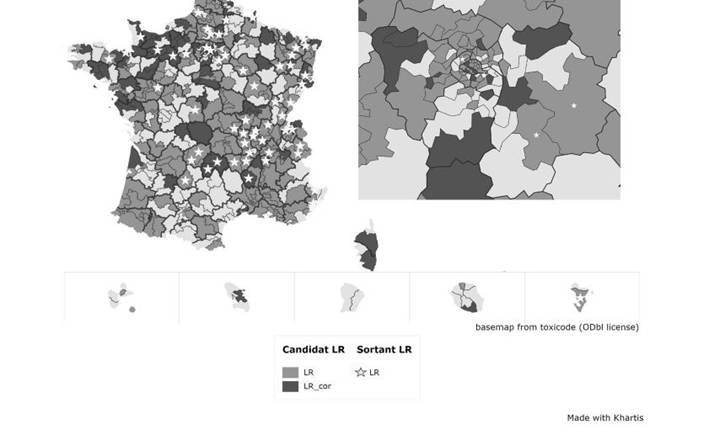
Fig. 11 LR candidacies in the 2024 legislative elections. Reading note: metropolitan and overseas constituencies are distinguished based on LR candidacies: absent (light), official LR (medium), LR assimilated (dark). A star indicates that the outgoing MP from this constituency belonged to the LR group.
Appendix 4
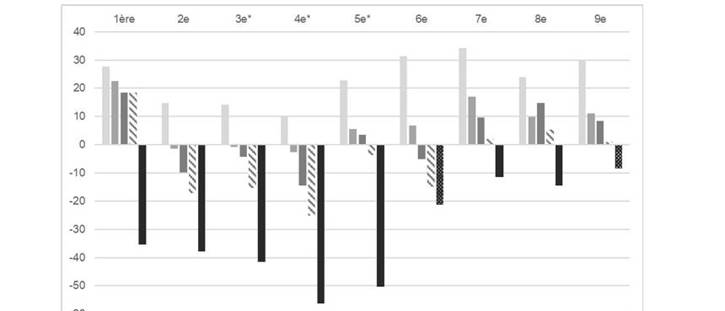
Fig. 12 Difference between LR and RN scores in the 2012, 2017, 2022, and 2024 legislative elections in the 9 Alpes-Maritimes constituencies. The 2022b bars (hatched) show the difference between LR’s score and the combined RN+R! score in 2022. The 2024 dotted bars (6th and 9th constituencies) indicate that no Ensemble candidate was present. Constituencies marked with an asterisk (3rd, 4th, and 5th) indicate that no LR candidate was present in 2024 (thus showing the RN score in negative).
References
Blanchard, Delphine. 2024. Des candidats façon puzzle. La Nouvelle République. 12 June
Bornschier, Simon, and Romain Lachat. 2009. The evolution of the French political space and party system.
West European Politics 32(2): 360–383.
Burnett, Craig M.., and Lydia Tiede. 2015. Party labels and vote choice in judicial elections. American
Politics Research 43(2): 232–254.
Butler, Chris, and Marta Miori. 2024. Inside the ‘secret garden’: Candidate selection at the 2019 UK general
election. The British Journal of Politics and International Relations 27(1): 242–269.
Dahani, Safia, et al. 2023. D’un parti à l’autre. Inconstances politiques, reconversions partisanes et professionnalisation.
In Sociologie politique du Rassemblement national. Enquêtes de terrain, ed. Safia
Dahani, 223–244. Villeneuve d’Ascq: Presses du Septentrion.
Dézé, Alexandre. 2003. Between adaptation, differentiation and distinction. Extreme right-wing parties
within democratic political systems. In Western democracies and the new extreme right challenge,
ed. Cas Mudde and Roger Eatwell, 19–40. London: Routledge.
Di Virgilio, Aldo. 1994. Dai partiti ai poli. La politica delle alleanze. Rivista italiana di scienza politica
24(3): 493–547
Duverger, Maurice. 1951. Les partis politiques. Paris: Armand Colin.
Ehrhard, Thomas. 2016. Le Front national face aux modes de scrutin : Entre victoire sous conditions et
influences sur le système partisan. Pouvoirs 157:85–103.
Gougou, Florent. 2022. La consolidation d’un nouvel ordre électoral ? Les élections françaises de 2022
dans la perspective des réalignements. Revue Française De Science Politique 72(6): 915–943.Gougou, Florent. 2025b. Le déploiement d’un nouvel ordre électoral ? Les élections françaises de 2024
dans la perspective des réalignements. Revue Française De Science Politique 75(3): 425–457.
Gougou, Florent, and Simon Labouret. 2013. Revisiting data on the 2012 French legislative elections:
Political supply, party competition and territorial divisions. French Politics 11(1): 73–97.
Gougou, Florent, and Simon Persico. 2017. A new party system in the making? The 2017 French presidential
election. French Politics 15(3): 303–321.
Gougou, Florent, Tristan Guerra, Simon Persico, et al. 2024. Tripartition et tripolarisation : Les contours
du nouvel ordre électoral. In Citoyens et partis après 2022, ed. Vincent Tiberj, 185–202. Paris:
Presses universitaires de France.
Gougou, Florent. 2025a. The French election results database (FERD). DEMC Journal (3).
Grunberg, Gérard., and Florence Haegel. 2007. La France vers le bipartisme ? La présidentialisation du
PS et de l’UMP. Paris: Presses de Sciences Po.
Grunberg, Gérard., and Étienne. Schweisguth. 1997. Vers une tripartition de l’espace électoral. In
L’électeur a ses raisons, ed. Daniel Boy and Nonna Mayer, 179–218. Paris: Presses de Sciences Po.
Houard-Vial, Emilien. 2022b. The French right-wing paradox – Maintaining the cordon sanitaire. Partecipazione
& COnflitto 15(2): 422–443.
Houard-Vial, Emilien. 2022a. La droite faible. La défaite des Républicains à l’élection présidentielle de
2022 à l’aune du réalignement électoral. Revue française de science politique 72(4): 538–562
Jacquet-Vaillant, Marion. 2023. L’extrême droite à l’épreuve de l’union. 2022 et la candidature d’Eric
Zemmour. Revue française de science politique 73(2): 227–257
Jacquet-Vaillant, Marion. 2024. Nouveauté du parti et renouvellement des partis. Construire un ‘nouveau
‘parti politique aujourd’hui, le cas de Reconquête. Paper presented at Sciences Po Toulouse, for the
study day ‘Les partis à l’inventaire”
Jaffré, Jérôme. 2023. Le macronisme reconduit mais diminue. In Le vote clivé, ed. Pascal Perrineau, 139–
152. Grenoble: Presses universitaires de Grenoble.
Kirkland, Patricia A., and Alexander Coppock. 2018. Candidate choice without party labels. Political
Behavior 40:571–591.
Krause, Werner, Denis Cohen, and Tarik Abou-Chadi. 2023. Does accommodation work? Mainstream
party strategies and the success of radical right parties. Political Science Research & Methods 11(1):
172–179.
LEGIS-2022. 2022. Codage des nuances politiques des candidats aux élections législatives des 12 et 19
juin 2022. Sciences Po. https://www.data.gouv.fr/datasets/legis-2022-codage-des-nuances-politiques-des-candidats-aux-elections-legislatives-des-12-et-19-juin-2022 . Accessed 20 March 2025
Lijphart, Arendt. 2012. Patterns of democracy. Government forms and performance in thirty-six countries.
2nd edition. New Haven: Yale University Press.
Marigot, Antoine. 2024. Législative : Baudino a quitté son poste de délégué départemental de Reconquête
des Bouches-du-Rhône. La Provence. 14 June
Martin, Pierre. 2000a. La transformation du paysage politique. Commentaire 89:79–90.
Martin, Pierre. 2000b. Comprendre les évolutions électorales. La théorie des réalignements revisitée.
Paris: Presses de Sciences Po.
Martin, Pierre. 2017a. Un séisme politique. L’élection présidentielle de 2017. Commentaire 158:249–264.
Martin, Pierre. 2017b. Les élections législatives des 11 et 18 juin 2017. Commentaire 159:525–534.
Moffitt, Benjamin. 2022. How do mainstream parties ‘become’ mainstream, and pariah parties ‘become’
pariahs? Conceptualizing the processes of mainstreaming and pariahing in the labelling of political
parties. Government & Opposition 57(3): 385–403.
Rouban, Luc. 2023. La droitisation ou le terminus du macronisme. In Le vote clivé, ed. Pascal Perrineau,
53–60. Grenoble: Presses universitaires de Grenoble.
Tiberj, Vincent. 2024. La droitisation française, mythes et réalités. Paris: Presses universitaires de France.
Valentim, Vicente. 2024. The normalization of the radical right: A norms theory of political supply and
demand. Oxford: Oxford University Press.
En savoir plus sur Fragments sur les Temps Présents
Abonnez-vous pour recevoir les derniers articles par e-mail.

